
 Chinese
1. Q: After a desert crossing, the chassis skid plate looks intact. Does that mean I don’t need to inspect it?
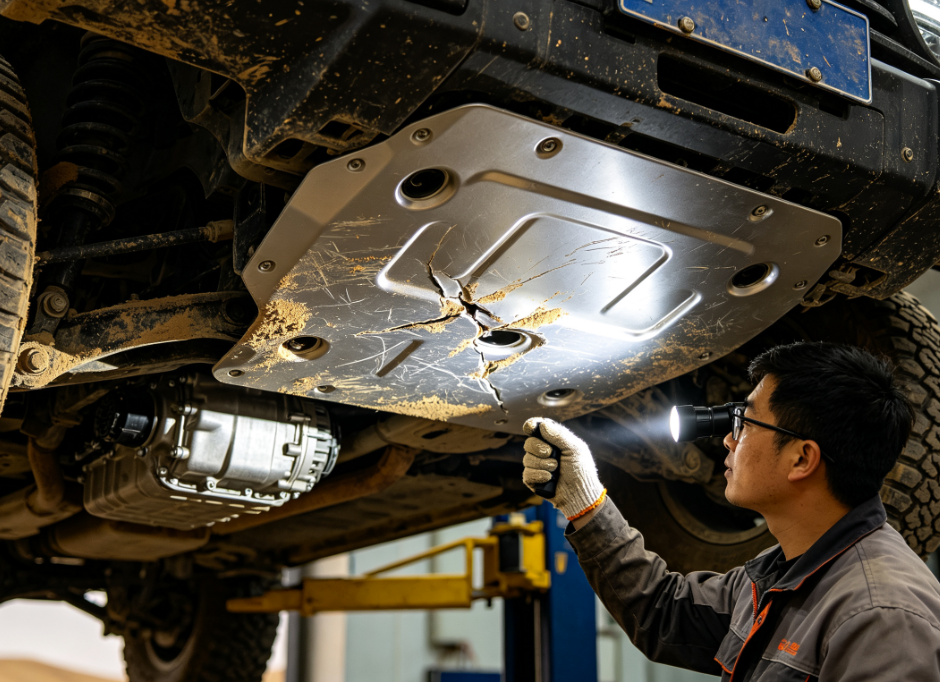
A: Absolutely not. The desert terrain may look flat, but it hides countless rocks, sharp stones, and deep ruts. At high speeds, even a minor scrape can cause “internal injuries” to the skid plate. These “invisible” damages, if not detected and addressed promptly, could lead to the skid plate breaking or falling off during the next off-road trip, potentially damaging critical components like the oil pan or gearbox that it’s supposed to protect.
Solutions:
– Lift and Inspect: As soon as you return from the desert, lift the vehicle on a hoist or with jacks to conduct a thorough, detailed inspection of the chassis skid plate.
– Focus on Key Areas: Carefully examine the edges of the skid plate, around the mounting bolt holes, and areas subject to constant stress for any hairline cracks, deformation, or broken welds that might be hard to see with the naked eye.
– Check Mounting Bolts: Use a torque wrench to check and tighten all the skid plate’s mounting bolts to the manufacturer’s specified torque. The constant vibration in the desert can easily loosen bolts.
2. Q: The chassis skid plate is dented but not broken. Can it still be used?
A: This depends on the severity and location of the dent. If it’s a minor, localised depression that doesn’t affect other components, it can usually continue to be used. However, if the deformation is severe, causing the gap between the skid plate and components like the oil pan or gearbox to become too small, or if friction has already occurred, it must be repaired or replaced immediately.
Solutions:
– Assess Deformation: Gently shake the skid plate by hand to check the clearance with surrounding components. If the skid plate is already “touching” other parts, it must be addressed.
– Repair or Replace: Minor dents can sometimes be corrected with tools. However, for severely deformed or cracked skid plates, it’s recommended to replace them with new ones for safety.
– Check Internal Components: While repairing or replacing the skid plate, always carefully inspect the components it protects (like the oil pan and gearbox) for any signs of impact or friction. Address any abnormalities promptly.
3. Q: Why does my chassis skid plate make noise on regular roads after a desert trip, even though it wasn’t hit much there?
A: This is a very common scenario. In the desert, the vehicle’s suspension is usually at a higher travel, providing more clearance between the skid plate and the ground, making collisions less likely. However, when returning to regular roads, the suspension settles back to its normal height, reducing the clearance. If the skid plate has already sustained minor damage or has loose bolts, it can easily collide with road irregularities (like speed bumps or the edges of manholes) or produce noise due to resonance while driving.
Solutions:
– Re-inspect and Tighten: Follow the advice in the first question to re-inspect and tighten the chassis skid plate thoroughly.
– Adjust Skid Plate Position: If the skid plate is deformed and sits too low, try adjusting the shims under the mounting bolts or slightly bending the skid plate to increase its clearance from the ground.
– Investigate Other Causes: If the skid plate itself is fine, the noise might be coming from other chassis components, such as suspension ball joints or stabilizer bar bushings. It’s advisable to check these as well.
4. Q: What material is best for a chassis skid plate? What are the pros and cons of manganese steel vs. magnesium-aluminum alloy?
A: The most popular materials for chassis skid plates on the market today are manganese steel and magnesium-aluminum alloy. Each has its own advantages and disadvantages, and the choice should be based on your primary usage scenario.
Comparison:
– Manganese Steel Skid Plate:
– Pros: High strength and excellent impact resistance. It can withstand very large forces, making it the top choice for high-intensity off-road activities like rock crawling.
– Cons: Heavy weight, which increases the vehicle’s overall weight and fuel consumption; prone to rust and requires regular anti-rust treatment.
– Magnesium-Aluminum Alloy Skid Plate:
– Pros: Lightweight, yet strong enough for most off-road scenarios (like desert and Gobi crossings). It doesn’t significantly add to the vehicle’s load and has good corrosion resistance, so it’s less likely to rust.
– Cons: Slightly inferior impact resistance compared to manganese steel. It may be more prone to deformation or fracture when hit by very sharp or large rocks.
Recommendation:
– If your primary activities involve desert or Gobi crossings, a magnesium-aluminum alloy skid plate offers better value for money.
– If you frequently tackle extreme terrain like rocks and steep slopes, a manganese steel skid plate will provide more reliable protection.