
 Chinese

When your off-road vehicle gets stuck in mud or ditch in remote areas and rescue support is unavailable, the winch becomes your core self-recovery gear.
This complete winch guide covers winch types, pulling capacity, cable options, installation methods and safe operation steps, helping off-road enthusiasts master winch knowledge for vehicle recovery.

1. Why Do 4×4 Vehicles Need a Winch?
Imagine you are driving alone in a remote area and get stuck with no cell service and no accompanying vehicles. You have two options: wait for random passing vehicles for rescue with uncertain waiting time, or use your winch to pull your vehicle out of mud pits or gullies by yourself.
A winch gives you self-rescue ability before external rescue arrives.
A winch is not mandatory for all off-road drivers:
✅ Recommended: Frequent trips to no-man’s-land, gobi and rainforest; group off-roading with mutual rescue demands.
⚠️ Not necessary: Mostly driving on paved roads, only occasional light off-road travel.
2. How To Choose A Winch | Types
(1) Classification by drive system
1. Electric Winch
Powered by vehicle battery.
Pros: Easy installation, flexible mounting positions, simple operation. It is the top pick for most off-road enthusiasts.
Cons: Prone to heat during continuous long operation, high power consumption.
Best for: Most 4×4 owners, works on standard 12V vehicle electrical system.
2. Hydraulic Winch
Driven by vehicle engine hydraulic system.
Pros: Runs continuously for long periods, high temperature resistance, stable pulling force.
Cons: Complex modification, high cost, requires changes to vehicle oil circuit.
Best for: Heavy-duty off-roading, engineering vehicles and extreme heavy-load recovery.
3. Mechanical PTO Winch
Power comes directly from engine via transfer case.
Pros: Extremely strong pulling force, no battery power consumption.
Cons: Complicated installation and heavy modification work.
Best for: Professional heavy off-road, trucks and extreme rescue missions.
Conclusion: For most 4×4 off-road owners, 12V electric winch is the preferred option, compatible with Tank, BAIC BJ and most hard-core off-road vehicles.
(2) Key Components of Electric Winch
– Motor: Series-wound motor is mainstream. High torque, compact size, determines pulling power.
– Clutch: Manual separation design for manually pulling out rope quickly to set anchor points.
– Brake: Automatically locks under load to prevent rollback. It is a critical safety component and must be reliable.
3. Select The Right Pull Rating | Follow The 1.5x Rule
Winch pulling strength is marked in pounds (lb), this is the core buying indicator.
✅ General rule: Winch maximum pulling capacity ≥ 1.5 times the vehicle curb weight.
Principle: The actual resistance during stuck recovery is much heavier than vehicle weight. Mud and sand create huge friction, the required pulling force can reach 2~3 times vehicle weight, so sufficient safety margin is essential.
Vehicle Reference Table
– Compact SUV (BJ40 etc.): Curb weight ~1.8t → Recommended:9000lb~10000lb
– Mid-size offroad (Tank300): Curb weight 2.0~2.4t → Recommended:10000~12000lb
– Full-size offroad (Tank500): Curb weight 2.4~2.8t → Recommended:12000lb+
Tip: Choose higher rather than lower rating. A higher pound winch has extra safety margin and less risk of overload during recovery. If budget allows, upgrade one level higher.
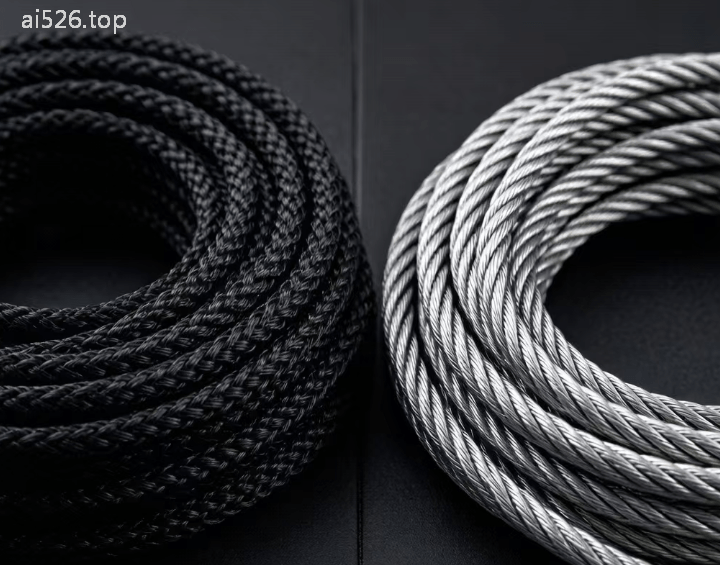
4. Steel Cable vs Synthetic Rope
Steel Cable
✅ Pros: Low cost, good wear resistance, resistant to sharp rock cuts.
❌ Cons: Heavy weight. Massive rebound force if broken, high risk of injury (must use safety dampener). Easy to rust and needs regular maintenance.
Best: Heavy recovery, rocky terrain with sharp stones.
Synthetic Nylon Rope
✅ Pros: Light weight, low rebound energy when broken for better safety, rust-free.
❌ Cons: Vulnerable to sharp rock abrasion and high temperature; UV rays cause aging over time.
Best: Most off-road enthusiasts for general overlanding, safer and won’t scratch vehicle paint.
Buying suggestion: Most players pick synthetic nylon rope for light weight and safety. If you regularly drive on sharp rocky trails, steel cable is an option. Always wear protective gloves during operation. Synthetic rope can be replaced separately later.
5. Purchase Reminder: You get what you pay for
Winch is life-saving recovery equipment. Low-quality cheap winches carry major risks such as motor overheating fire and cable snapping injury.
Buying suggestion: Choose certified quality products. Evaluate waterproof rating, heat dissipation and wireless safety features comprehensively instead of only comparing prices.
3 critical check points:
1. Waterproof rating: Minimum IP67. For frequent wading, select fully sealed IP68.
2. Heat dissipation: Built-in fan or thermal structure, avoids shutdown under long continuous work.
3. Wireless remote control: Wireless remote lets users stay away from danger zone and improve safety.
6. Two Installation Options: Front Bumper Mount & Quick Detachable
Option 1: Fixed Built-in Mount (Front Bumper)
Winch installed inside dedicated cavity of front off-road bumper.
✅ Pros: Ready to use anytime, neat appearance, good protection.
❌ Cons: Requires modified front bumper, adds front weight and affects suspension and steering.
Note: Total added weight is roughly 30~50kg, check suspension load capacity before modification.
Option 2: Quick Detachable Winch
No cutting or body modification. Fixed on factory tow hitch with special bracket, removable when not needed.
✅ Pros: Non-destructive installation. Remove to reduce front weight, one winch shared for multiple vehicles.
❌ Cons: Needs assembly before recovery, longer prep time, average anti-theft performance, exposed look.
Best for: Owners who avoid big modification and only need rescue occasionally.
Installation Rules
– Mounting bracket must use high-strength bolts tightened to specified torque.
– Verify the structural strength of bumper and bracket before installation.
– Wiring must follow standard electrical requirements. Never tap power from cigarette lighter.
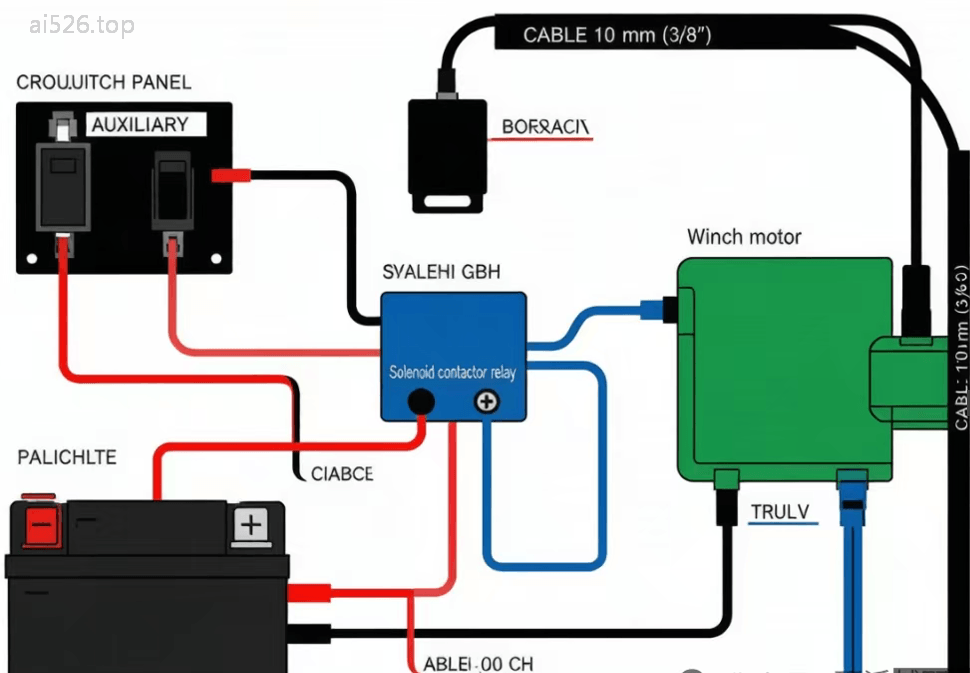
7. Wiring Guide: Electric System Is Critical For Winch
Winch draws huge peak current, up to 300~400A. Improper wiring will blow fuse and even cause fire.
Standard wiring requirements:
1. Power source: Directly connect positive terminal of battery, use large gauge copper wire and shorten cable length.
2. Circuit breaker: Install heavy-duty breaker or fuse to protect vehicle circuit.
3. Relay control: Heavy-duty electromagnetic relay to protect control switches.
4. Remote controller: Wired or wireless remote for operation inside cabin.
5. Grounding: Reliable ground connection on battery negative terminal with clean tight contact point.
Common Mistake Alert
Never use cigarette lighter or thin factory wiring for power supply; insufficient current will burn wires. Seal all joints with heat shrink tube especially for wading use.
Ensure battery is in good condition. Winch drains battery heavily; avoid continuous operation when battery is weak.
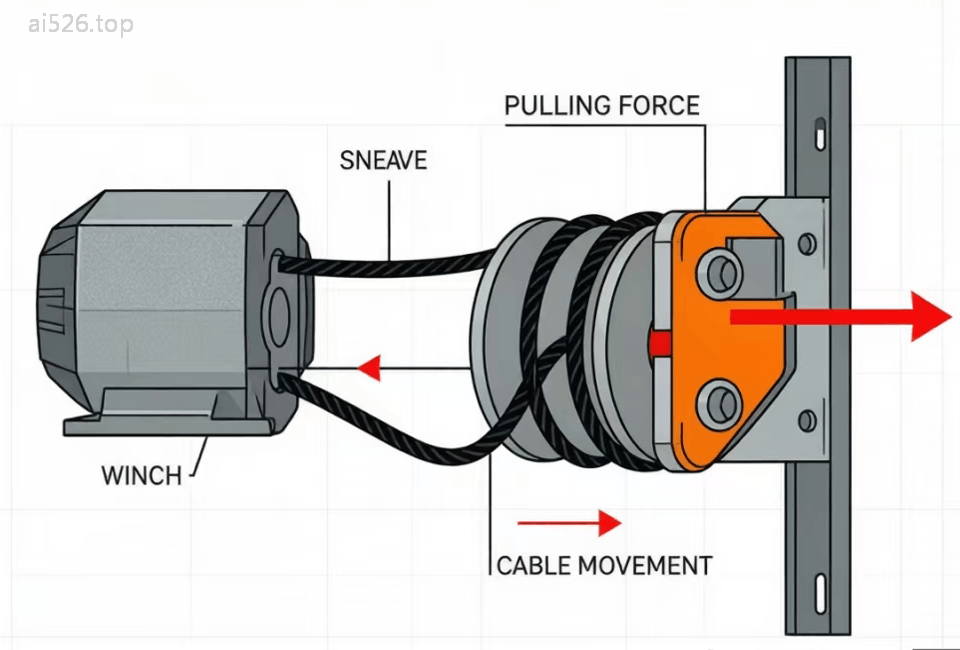
8. Snatch Block: Double Your Winch Pulling Force
Snatch block can change pulling direction and multiply pulling force, it is advanced off-road recovery accessory.
Principle: Rope loops through snatch block and anchors on fixed point. Pull force can be doubled in theory; multi-block setup can multiply force up to 4 times or more.
Suitable scenarios:
– Winch pulling power is insufficient
– Need side pulling to free stuck vehicle
Note: While snatch block amplifies pulling force, it also increases motor current. Operate intermittently to prevent motor overheating.
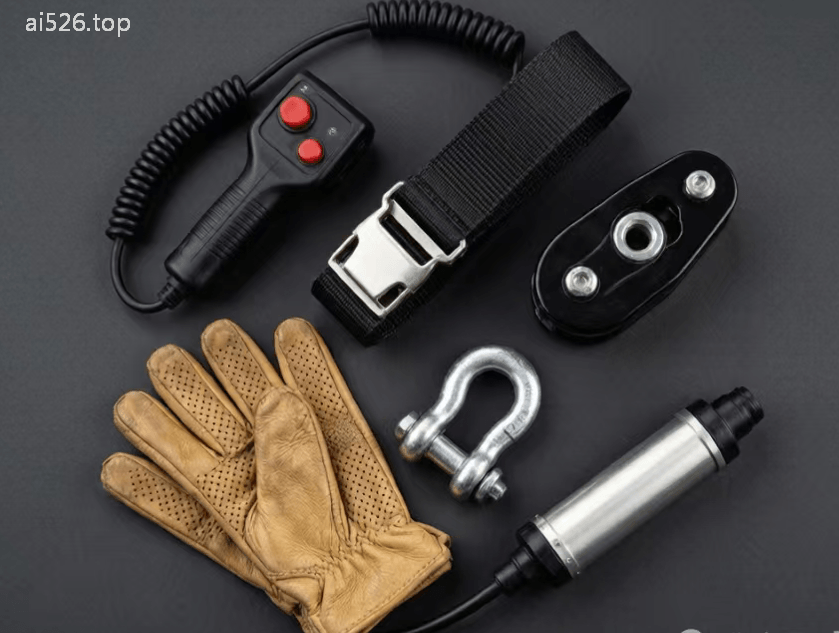
9. Full Recovery Accessory Kit
Winch cannot work alone. A full set of recovery gear handles all stuck scenarios.
– Tree saver strap: Protect tree anchor point and bark
– Shackles: Connect rope, snatch block and recovery points
– Snatch block: Boost pull force & change pulling angle
– Rope dampener: Absorb rebound energy if rope breaks
– Work gloves: Hand protection against cuts
10. 7 Step Standard Winch Operating Procedure
Step1: Site assessment, check vehicle condition, anchor point and pulling angle.
Step2: Disengage clutch and pull out enough rope length.
Step3: Secure anchor point with tree saver and shackle on solid anchor.
Step4: Attach rope dampener, evacuate all personnel to safe zone.
Step5: Tighten rope for pre-tension and double check all connections.
Step6: Pull slowly, continuously observe rope and anchor condition.
Step7: After recovery, retract rope, re-engage clutch and pack up gear.
⚠️ Critical Safety Rules
1. Stand on the sides of cable. Never stand directly in line with the rope, avoid injury from snapping rope rebound.
2. Do not use knotted rope for winching, knots easily cause cable breakage.
3. Do not run winch continuously for long time, stop and cool down when overheated.
4. Inspect rope and shackles for wear or cracks before each use.
5. No passengers are allowed inside the vehicle during winch recovery.
11. Common Pitfalls: 7 Mistakes In Winch Selection & Operation
1. Only focus on lb rating while ignoring rope capacity and continuous working performance.
2. Select winch rating just equal to vehicle weight without 1.5x safety margin.
3. Simplify wiring with thin wire and cause overheating hazard.
4. Use synthetic rope on sharp rocky terrain, rope easily gets cut.
5. Choose unstable anchor point, anchor may fail during pulling.
6. Stay within the rope rebound danger zone during recovery.
7. Keep running winch after overheating and burn out the motor.