
 Chinese
The desert is the ultimate holy land for off-road enthusiasts. The rolling dunes and the vast expanse of sand pose extreme challenges to vehicle performance, driver skill, and team coordination. A detailed guide is your essential weapon for conquering the sand sea.
 I. Vehicle Preparation: The Balance Between Lightweight and Passability
The core of desert crossing is “lightness and agility”. All modifications should serve this goal.
1. Suspension and Tires:
– Suspension: A 1.5-2.5 inch lift is recommended to provide sufficient ground clearance for the undulating dunes and unknown hidden terrain. Meanwhile, choosing shock absorbers with adjustable damping can better absorb the bumps of desert driving.
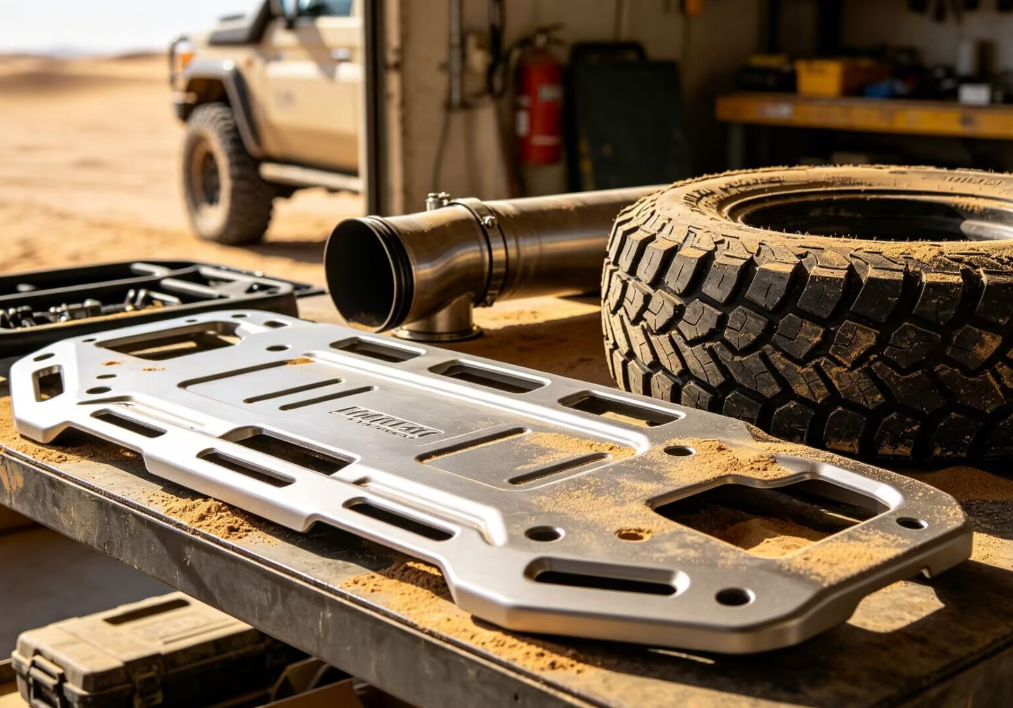
– Tires: AT all-terrain tires are the first choice. While providing sufficient grip, they have relatively lower tire noise and fuel consumption compared to MT mud-terrain tires, making them more suitable for long-distance high-speed crossings. Tire pressure is the lifeline of desert driving! Depending on the softness of the sand, the front tires are usually deflated to 1.0-1.5 bar and the rear tires to 0.8-1.2 bar to increase the tire’s contact area and prevent getting stuck.
2. Chassis and Protection:
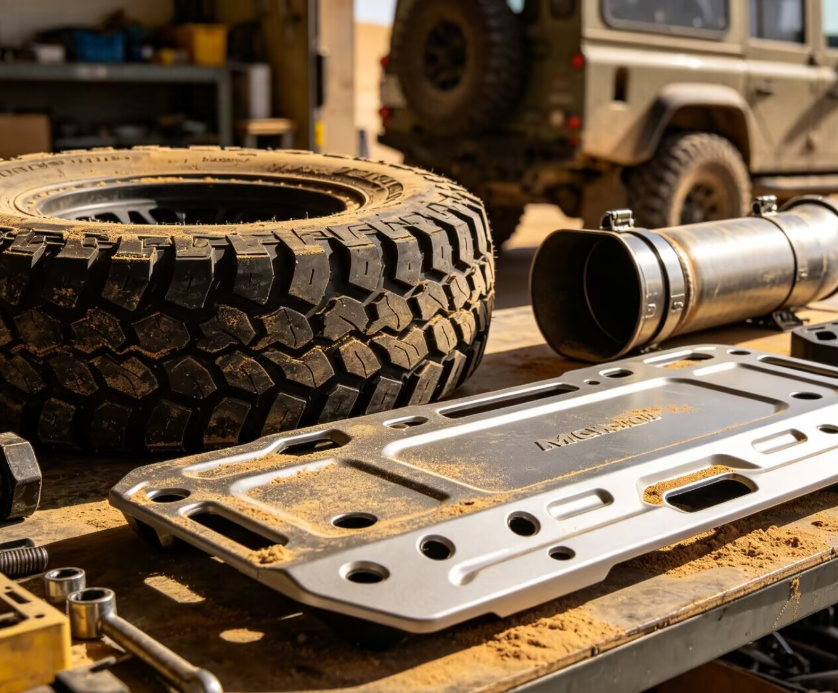
– Chassis Skid Plates: Must be installed! Magnesium-aluminum alloy is recommended, which maximizes weight reduction while ensuring sufficient strength, protecting the engine, gearbox, and fuel tank from bottoming damage.
– Front and Rear Bumpers: Choose lightweight competition bumpers, which can provide basic protection without adding front-end weight like heavy-duty bumpers, affecting the vehicle’s flexibility and climbing ability.
3. Other Key Modifications:
– High-Mount Intake (Snorkel): Highly recommended. Driving in the desert kicks up a lot of dust, and a high-mount intake allows the engine to intake cleaner, cooler air, avoiding dust damage to the air filter and engine.
– Roof Rack: It is recommended to use a lightweight platform roof rack and plan the loaded items reasonably. Place heavy items (such as water tanks, oil barrels) as close as possible to the vehicle’s center of gravity, and avoid too high or too light items on the roof that increase wind resistance and instability.
– Auxiliary Fuel Tank: Essential! Supply points in desert areas are scarce. An auxiliary fuel tank with sufficient capacity (usually an increase of 50-100 liters is recommended) gives you the confidence to explore further uninhabited areas.
II. Essential Gear List: Guarantee for Survival and Rescue
The desert environment changes rapidly, and sufficient equipment is the basic guarantee for team safety.
(A) Vehicle Tools and Rescue Equipment
– Inflation Equipment: A high-power car air compressor or portable air compressor for quickly inflating tires after exiting the desert.
– Rescue Tools: Recovery boards (sand ladders), Hi-Lift jacks, tow ropes (or straps), and D-rings are the “Four Great Kings” of desert rescue, and none are indispensable.
– Other Tools: Engineer shovel, tire repair tools, spare tire, engine oil, antifreeze, and a complete set of vehicle tools.
(B) Personal and Team Survival Equipment
– Navigation and Communication: A professional off-road navigator (such as Garmin) and a satellite phone are reliable guarantees for desert communication and positioning. Mobile phone signals are basically zero in the desert.
– Water and Food: Carry at least 3-5 days of drinking water and high-calorie, easy-to-preserve food. Water is gold in the desert, so it is necessary to plan and distribute it strictly.
– Clothing and Sun Protection: The temperature difference between day and night in the desert is extremely large, with hot and sunny days and cold nights. It is necessary to carry quick-drying clothes and pants, warm jackets, windproof and sandproof headgear, sunglasses, and high-power sunscreen.
– Medical Kit: Prepare a first-aid kit containing cold medicine, gastrointestinal medicine, trauma medicine, heatstroke prevention medicine, and personal commonly used medicines.
– Others: Headlamp, strong flashlight, lighter, matches, knife, GPS locator, and enough cash.
III. Desert Driving Techniques: The Art of Power and Rhythm
Desert driving emphasizes the combination of “speed” and “stability”. It requires boldness and carefulness, as well as pre-judgment and operation.
1. Starting and Accelerating:
– When starting, slowly release the clutch and gently step on the accelerator to make the vehicle start smoothly and avoid the wheels spinning and digging holes.
– When driving in the desert, maintaining a certain speed is the key. If the speed is too slow, the vehicle is easy to get stuck; if the speed is too fast, it will lose control, and the risk factor is extremely high.
2. Climbing Skills:
– Rushing up the slope: Observe the slope and wind direction of the dune, and choose the appropriate route and entry point. Accelerate in advance, maintain sufficient power, and rush up to the top of the slope in one go.
– Passing the top of the slope: When reaching the top of the slope, release the accelerator in time and gently step on the brakes to let the front of the vehicle droop slowly. After seeing the road conditions of the downhill, continue driving to avoid “flying” or losing control.
3. Downhill and Avoiding Dangers:
– When going downhill, engage low-range four-wheel drive (L4) and use engine braking to control the speed. Try to avoid stepping on the brakes.
– In case of vehicle loss of control or impending rollover, stay calm and hold the steering wheel firmly to make the vehicle roll along the slope of the dune as much as possible and avoid vertical impact.
4. Getting Stuck and Self-Rescue:
– Once stuck, don’t panic, and don’t slam on the accelerator, as this will only make you more stuck.
– First, get out of the vehicle and observe to analyze the cause of getting stuck and the surrounding terrain. Then, dig away the sand around the front and rear of the wheels to form a gentle slope. If you have companions, you can push the vehicle together.
– If you cannot get out on your own, immediately use the recovery board or seek rescue from other vehicles.
IV. Safety and Environmental Protection: The Bottom Line of Desert Travel
– Safety First: Never enter the desert uninhabited area alone. Before departure, be sure to tell your family or friends your detailed itinerary and expected return time.
– Teamwork: In the desert, the strength of the team is infinite. Obey the command, help each other, and advance and retreat together.
– Leave No Trace: The desert ecosystem is extremely fragile. Please take all garbage (including food residues, mineral water bottles, paper towels, etc.) out of the desert to achieve “Leave No Trace” crossing and protect this beautiful sand sea.